TL;DR: Coaching frameworks give leadership development structure. They help coaches and leaders focus on the right behaviors, track progress between sessions, and turn insight into action. Instead of vague growth goals, a good framework makes capacity, habits, and follow-through visible. That means stronger conversations, clearer priorities, and leadership change that actually sticks.
Leadership development often fails for a simple reason. People know what to improve, but they do not have a practical way to keep improving it. Coaching frameworks solve that problem. They turn leadership growth into a repeatable process with clear signals, defined experiments, and measurable progress. For coaches working with executives, founders, and senior operators, that structure matters. It keeps the work human, but also accountable.
What is a coaching framework in leadership development?
A coaching framework is a structured way to guide a conversation, set goals, test behavior change, and review progress. In leadership development, it gives the coach and leader a shared map. That map can cover performance capacity, communication, decision-making, resilience, delegation, or team influence.
The best frameworks do not box people in. They create focus. A leader might say they want to become more strategic, but that is too broad to coach well. A framework helps break that into smaller questions. What are they protecting their time from? Where is their energy dropping? Which habits support better decisions? What does success look like in a real week, not just on paper?
At PrescribeLife.AI, this is where performance intelligence becomes useful. The platform helps coaches make between-session performance visible, so the work does not depend on memory or vague self-reporting. That makes coaching more continuous, and leadership development more measurable.
Why do coaching frameworks matter for leadership growth?
Leadership growth is rarely a knowledge problem. Most senior people already understand the theory. The challenge is consistency under pressure. A coaching framework helps by turning broad ambition into a series of practical steps.
Here is what that looks like in practice:
- Clarity: It narrows the focus to one or two leadership priorities.
- Continuity: It keeps the work active between sessions, not just during them.
- Accountability: It makes commitments visible and reviewable.
- Pattern recognition: It shows where behavior changes break down.
- Proof of progress: It gives coaches and clients evidence that something is shifting.
Without a framework, coaching can become a series of good conversations with weak follow-through. With a framework, those conversations build on each other. That is what makes development stick.
Which coaching frameworks work best for leadership development?
There is no single perfect model. The right framework depends on the client, the coaching style, and the leadership challenge. Still, the strongest frameworks usually share a few traits. They are simple, repeatable, and tied to real behavior.
Many coaches use goal-setting models, reflection cycles, accountability loops, or behavior-change experiments. In leadership development, the most useful frameworks often include these elements:
- Current state: What is happening now?
- Desired state: What does better look like?
- Barrier analysis: What gets in the way?
- Experiment: What small action will test a new approach?
- Review: What changed, and what did we learn?
This kind of structure works because leadership is behavioral. It shows up in meetings, decisions, energy levels, and relationships. A framework that tracks those signals gives the coach a better basis for insight.
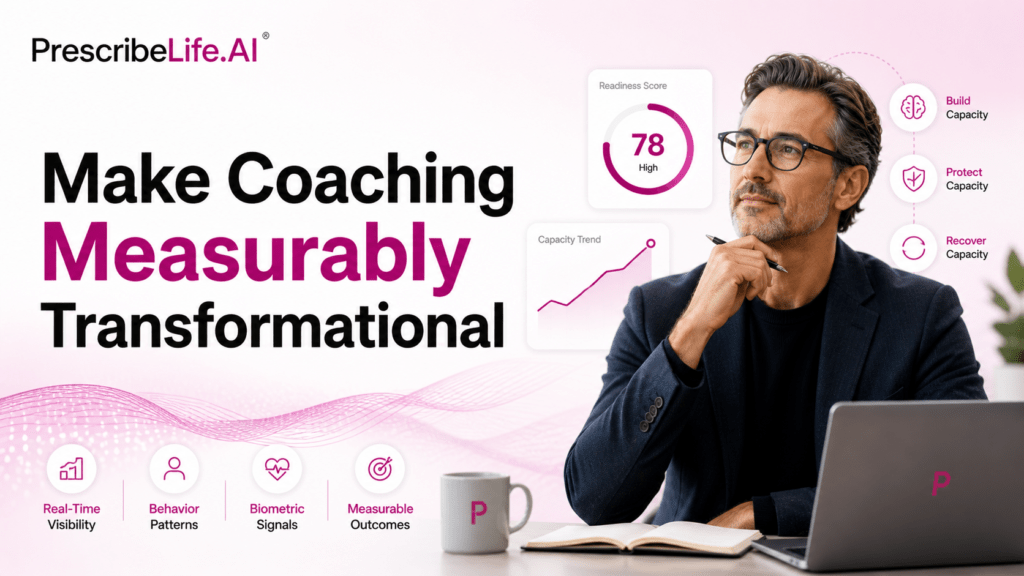
PrescribeLife.AI supports this kind of work through a performance-capacity model and a simple build, protect, recover approach. That lets coaches look beyond surface goals and see whether a leader has the capacity to sustain the change they want.
How do coaching frameworks improve leadership conversations?
Good coaching conversations are not random. They are shaped by a clear process. A framework helps the coach ask better questions, notice patterns faster, and avoid getting stuck in abstract advice.
For example, instead of asking, “How did the week go?” a coach might ask:
- What drained your capacity most this week?
- Where did you protect your time well?
- Which leadership behavior showed up under pressure?
- What did you notice in your team’s response?
- What will you test before we meet again?
These questions create a cleaner line between reflection and action. They also help the coach and leader spot early signals. If readiness drops, sleep worsens, or habits slip, the conversation can shift before performance suffers. That is one reason visibility between sessions is so valuable.
PrescribeLife.AI’s coaching dashboard and mobile app are built around that idea. They help surface patterns that are easy to miss in a monthly session. The result is sharper coaching and better continuity.
How do coaching frameworks make leadership development measurable?
Leadership development has long struggled with proof. People can feel that coaching is helping, but they cannot always show how. Frameworks improve this by tying development to observable signals.
Measurable leadership growth does not need to be complicated. It can include:
- Consistency of key habits
- Readiness or energy trends
- Follow-through on agreed experiments
- Changes in delegation or decision speed
- Improvement in self-awareness and reflection quality
For example, a leader might improve an activity driver from 5 to 8, raise gym consistency from 40 percent to 80 percent, or see readiness increase by 10 points. Those are not vanity metrics. They are signals of better capacity, which often supports better leadership behavior.
This is where PrescribeLife.AI adds value for coaches. It helps make progress visible without reducing leadership to a spreadsheet. Coaches can see what is changing, what is not, and where to adjust the plan.
How do coaching frameworks support sustainable leadership, not just short-term change?
Short-term change is easy to coach. Sustainable change is harder. A leader can try a new behavior for a week and still fall back under pressure. Frameworks help sustain progress by connecting behavior change to capacity, not just willpower.
That matters because leadership strain is often hidden. High performers can look fine while running close to empty. If a framework includes build, protect, and recover, it can surface the cost of overextension early. That gives the coach a way to protect the client’s long-term performance, not just their next quarter.
In practice, this means coaching does not stop at “Do more of this.” It moves toward questions like:
- What needs to be protected in order to lead well?
- What is the smallest useful experiment?
- How will we know this change is sustainable?
- What pattern tells us capacity is improving or fading?
That is the difference between a motivational conversation and a development system.
How can coaches use frameworks to strengthen their own practice?
Coaching frameworks do not only help the client. They also help the coach run a better business. When the work is structured, it becomes easier to show value, retain clients, and create premium offers around measurable outcomes.
For boutique leadership coaches, this can mean stronger renewals and more natural upsell conversations. If a client sees clear progress in capacity, habits, and leadership behavior, the case for ongoing work becomes easier to make. The coach is no longer selling abstract support. They are showing a visible development arc.
PrescribeLife.AI is designed for that kind of practice. It supports premium 1:1 and small-group coaching with tools that make progress easier to see, discuss, and prove.
What is the simplest way to start using a coaching framework?
Start small. Pick one leadership goal, one behavior to track, and one weekly experiment. Then review the result in the next session. Keep the framework simple enough to use consistently.
A practical starting point is:
- Define the leadership outcome
- Identify the capacity needed to support it
- Select one habit or behavior to change
- Set a clear test for the next 7 days
- Review what happened and adjust
That is enough to create momentum. Over time, the framework can expand to include more signals, better pattern recognition, and deeper reflection. The point is not complexity. The point is continuity.
If you want to see how this works in a real coaching environment, explore what performance capacity means for coaches and how it supports sustainable leadership growth. You can also review build, protect, recover as a simpler model for sustainable high performance for a practical framework you can use with clients.
Leadership development gets better when it is visible, structured, and tied to real behavior. Coaching frameworks make that possible. They help coaches guide the process, help leaders stay accountable, and help both sides see progress with more confidence.
Related questions
What is the main purpose of a coaching framework?
The main purpose is to give coaching structure. It helps the coach and client focus on a clear goal, test behavior change, and review progress in a repeatable way.
How do coaching frameworks help executive leaders?
They help executive leaders turn broad goals into specific actions. That makes it easier to improve decision-making, delegation, resilience, and follow-through under pressure.
Can coaching frameworks measure leadership progress?
Yes. They can track habits, readiness, energy, reflection quality, and other visible signals. This gives coaches a clearer view of whether leadership behavior is changing.
Why is visibility between coaching sessions important?
Because most leadership behavior happens between sessions. Visibility helps coaches spot patterns early, adjust the plan, and keep development moving when real work gets busy.
How does PrescribeLife.AI support coaching frameworks?
PrescribeLife.AI helps coaches make performance visible between sessions, track capacity and habits, and show proof of progress. That supports sharper conversations and more sustainable leadership development.
What should a coach track first with a new client?
Start with one leadership outcome, one capacity signal, and one behavior experiment. Keep it simple so the client can stay consistent and the coach can see what is actually changing.