
High performance gets rewarded.
From the outside, it often looks like the goal. Better results. Bigger responsibilities. More visibility. More trust. More pressure.
But coaches who work with high-performing clients know something important:
Performance is not always the problem. Sustainability is.
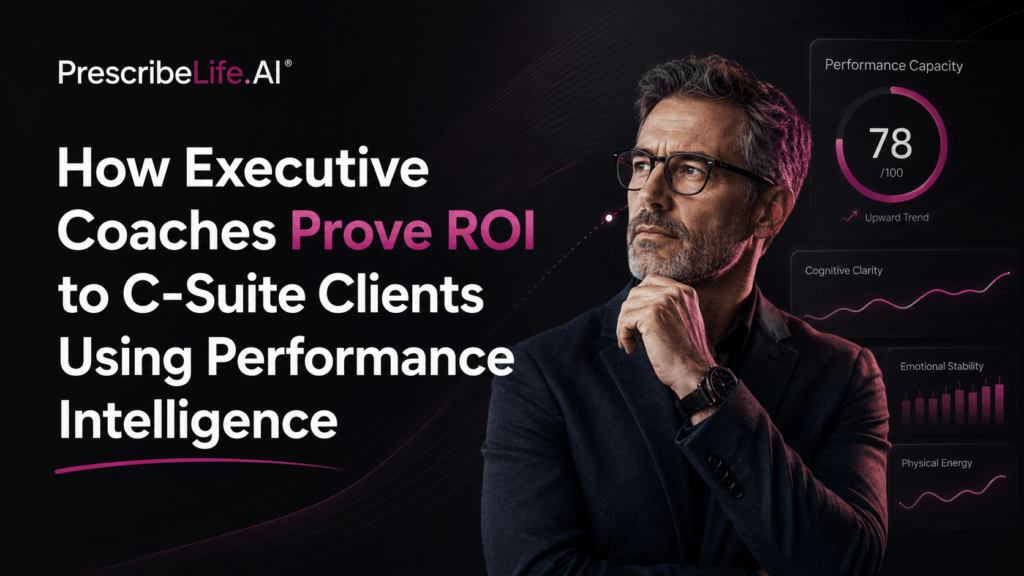
A client can look successful and still be operating on unstable foundations. They may be producing results while dealing with chronic stress, declining recovery, reduced clarity, emotional volatility, or growing burnout risk. That tension sits at the heart of why performance capacity matters. The PrescribeLife onboarding deck frames this clearly: many high-performing leaders succeed despite unhealthy patterns, and over time those patterns can reduce cognitive clarity, increase burnout risk, and destabilize leadership performance.
That is where performance capacity becomes such a useful coaching idea.
What is performance capacity?
Performance capacity is the underlying ability that allows someone to perform well consistently without paying for it with instability, exhaustion, or burnout.
It is not just about whether a client can push hard in one moment.
It is about whether they can:
- sustain clarity under pressure
- regulate emotions when demands rise
- maintain energy and recovery over time
- stay consistent in the behaviors that support performance
- rebound when performance dips
In simple terms, performance capacity is what sits underneath visible performance.
The PrescribeLife framework connects leadership performance directly to personal capacity and positions sustainable high performance as something that must be built intentionally, not assumed.
Why this matters in coaching
Many coaching engagements focus on goals, decisions, communication, accountability, and results.
All of that matters.
But when the client’s internal capacity is weak, even smart strategies become harder to sustain.
This is where many coaching relationships quietly hit friction.
The client may say:
- “I know what I should do, but I’m struggling to follow through.”
- “I’m performing, but it feels expensive.”
- “I can keep going, but I’m not recovering well.”
- “I’m getting results, but I don’t feel stable.”
These are not always motivation problems.
Often, they are capacity problems.
That distinction matters because it changes the coaching conversation.
Instead of asking only, “How do we get better results?”
the better question becomes, “How do we help this person sustain strong performance without depleting the capacity that makes performance possible?”
That shift is central to the PrescribeLife positioning. The deck states that most leadership coaching improves business results, but fewer systems build measurable performance capacity.
Performance is visible. Capacity is foundational.
One reason this topic is so important is that performance is easy to notice, while capacity is easier to miss.
A client may still be achieving targets.
They may still appear composed.
They may still be leading at a high level.
But underneath that, there can be growing strain:
- reactive decision-making
- poor recovery
- inconsistent habits
- rising stress load
- reduced cognitive sharpness
- emotional friction
The challenge for coaches is that these issues often appear before an obvious collapse, but after performance has already started becoming more costly.
This is why performance capacity gives coaching a stronger foundation. It helps coaches work on what makes performance sustainable, not just what makes it impressive in the short term.
A practical way to understand performance capacity
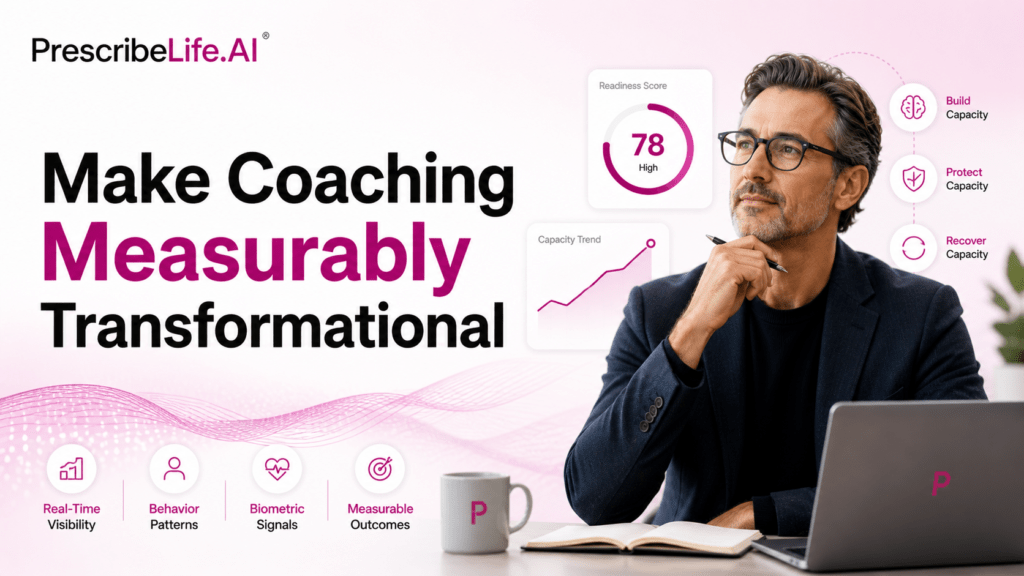
PrescribeLife uses a simple model that makes this easier to communicate: build, protect, recover.
That matters because clients rarely need more complexity. They need a framework that makes sense quickly and can be applied in real life.
1. Build capacity
Building capacity means expanding a client’s ability to perform well on purpose.
This includes strengthening the patterns that support performance, such as:
- better awareness
- stronger routines
- improved consistency
- healthier inputs
- smarter responses to pressure
The goal is not just to help a client “work harder.”
The goal is to help them become more capable of sustaining output without unnecessary friction.
2. Protect capacity
Protecting capacity means reducing the patterns that drain performance stability.
This includes noticing:
- overextension
- erratic habits
- poor boundaries
- avoidable decision fatigue
- recovery blind spots
A high-performing client may already know how to accelerate.
Often what they need is help maintaining stability under sustained demand.
That protective layer is one of the most overlooked parts of coaching.
3. Recover capacity
Recovery is not the opposite of performance.
It is part of performance.
Recovering capacity means helping clients rebound efficiently when performance dips, stress rises, or energy drops.
This is critical because even strong performers will face periods of strain. The question is not whether a dip happens. The question is whether the client has the system, habits, and visibility to recover well when it does.
The resilience connection
The onboarding deck also grounds sustainable high performance in resilience capacity, organized around three areas:
- cognitive capacity
- emotional regulation
- physical energy stability
This is useful because it gives coaches a more complete picture of what “capacity” actually means.
A client is not just a calendar, a revenue goal, or a habit score.
They are performing through a full human system.
If cognitive capacity drops, decision-making suffers.
If emotional regulation weakens, pressure becomes harder to navigate.
If physical energy stability falls, consistency gets harder to maintain.
When those three areas strengthen together, performance becomes more stable.
That is why performance capacity is not a soft idea. It is a strategic coaching advantage.
Why coaches need a measurable model
One of the biggest reasons performance capacity matters is because it gives coaches something clearer to observe, develop, and communicate.
Without a model, many coaches can sense burnout risk or unsustainable patterns, but they do not always have a structured way to address them.
The deck makes this shift explicit. It moves from “I can see burnout risk, but I don’t have a structured way to address it” to “I systematically develop and measure performance capacity alongside business performance.”
That is a big difference.
It changes coaching from:
- reactive to structured
- intuitive to measurable
- supportive to strategically valuable
And it helps the client see progress more clearly too.
What progress can look like
Performance capacity becomes much easier to trust when clients can see signs of growth.
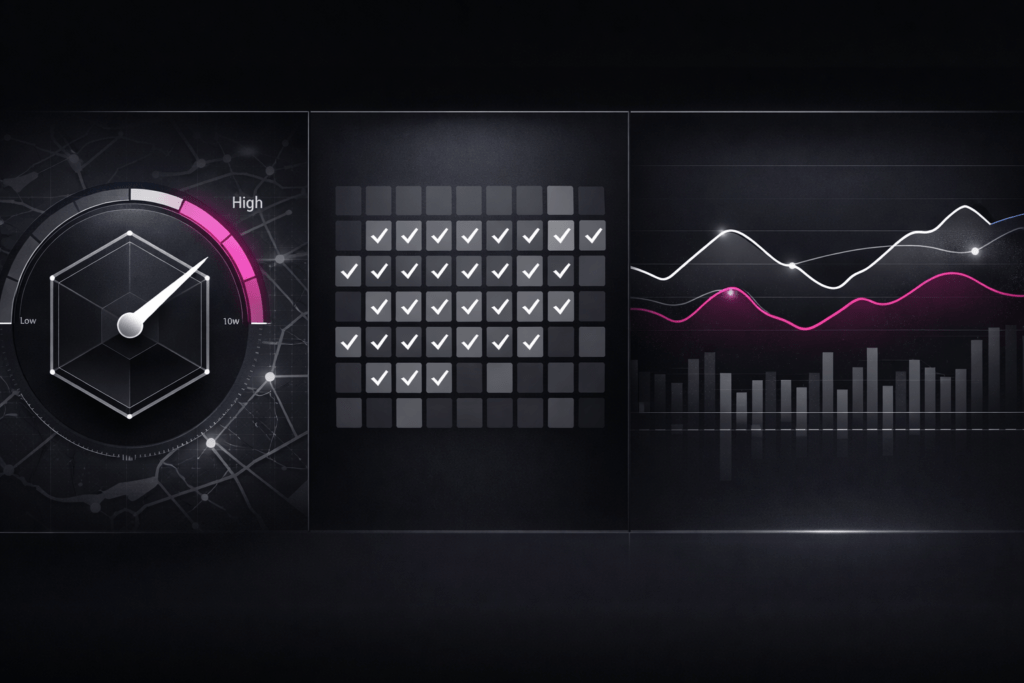
The PrescribeLife deck points to three areas coaches can use to measure progress:
- resilience capacity increases
- habit consistency improves
- biometric signals improve
That matters because coaching value becomes easier to communicate when progress is visible across multiple layers.
For example:
- a resilience driver improves
- a client follows through on key habits more consistently
- readiness or recovery trends improve from baseline
When those patterns move together, coaching no longer feels vague.
It starts to feel grounded, directional, and meaningful.
Why clients respond well to this idea
Clients, especially high-performing ones, do not always want another abstract conversation.
They want clarity.
They want to understand:
- what is happening
- why it matters
- what to do next
- how to know whether it is working
Performance capacity helps with all four.
It gives the coach a better explanation for why results may feel costly.
It gives the client a more intelligent goal than “just push harder.”
And it creates a bridge between coaching insight and everyday behavior.
That bridge matters because real transformation does not happen through awareness alone. It happens when awareness turns into experiments, habits, pattern review, and adjustment. The deck reflects this through the coaching workflow of creating clarity, defining success, designing small experiments, reviewing patterns, and adjusting over time.
Why performance capacity also matters for coach positioning
This idea is not only useful in delivery. It is useful in positioning.
A coach who speaks only about motivation, growth, or leadership may sound broad.
A coach who helps clients build and measure performance capacity sounds more specific, more structured, and more differentiated.
That does not mean becoming overly technical.
It means being able to say, with confidence:
“I help clients improve performance in a way they can actually sustain.”
That is a stronger promise.
It feels more relevant to high-performing professionals who are not just chasing results, but trying to maintain them without paying for them with instability.
Final thought
Performance capacity matters because it helps coaches focus on the thing beneath the thing.
Not just visible performance.
Not just short-term wins.
But the capacity that makes high performance sustainable.
When coaches help clients build capacity, protect capacity, and recover capacity, they are doing more than improving outcomes.
They are helping clients perform with more clarity, more stability, and less hidden cost.
And in a market where many coaching offers sound similar, that is not just good delivery.
It is smart positioning.