One of the biggest challenges in coaching is not helping clients improve.
It is helping them see improvement clearly.
A client may feel different.
A coach may sense progress.
The conversations may be getting stronger.
Patterns may be shifting in the right direction.
But if progress stays vague, it becomes harder to reinforce, harder to explain, and harder to build confidence around.
That is why measurable signals matter.
Not because coaching should become cold or mechanical.
But because visible progress strengthens belief, sharpens decision-making, and makes it easier for both the coach and the client to understand what is actually changing.
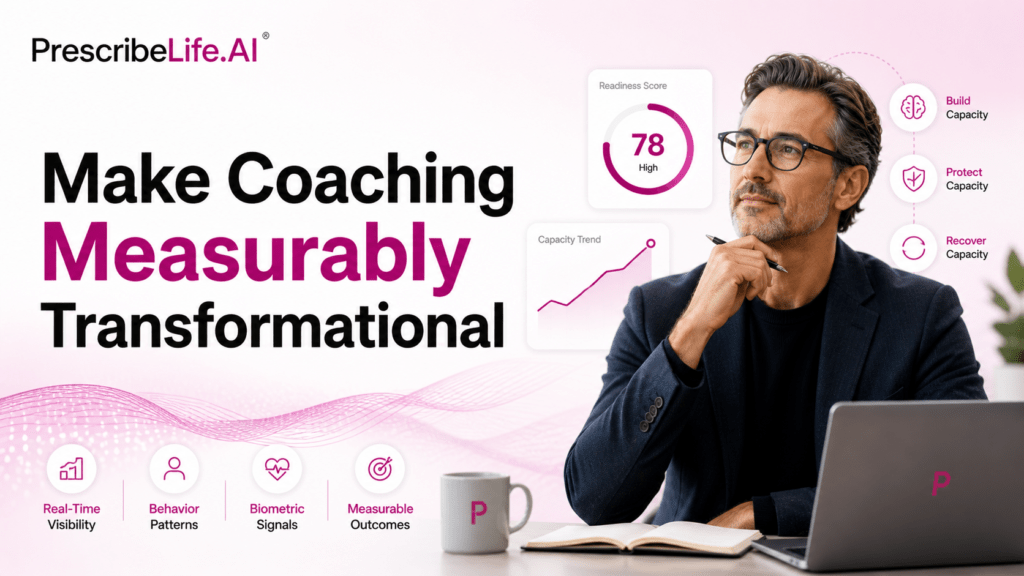
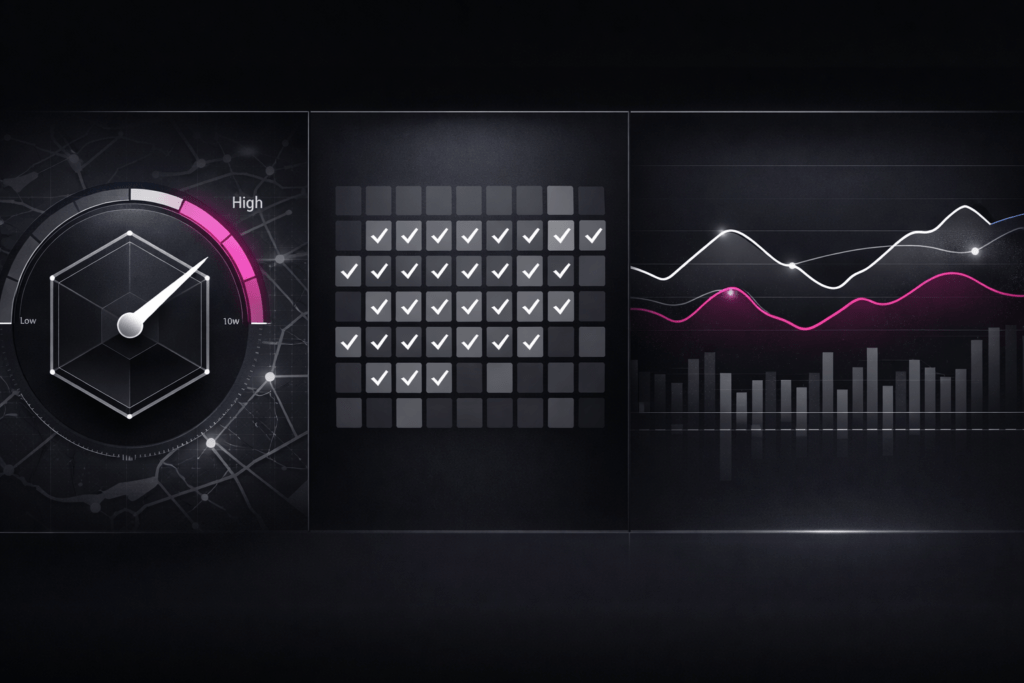
The PrescribeLife onboarding deck makes this concrete by showing that performance capacity growth can be measured across three areas:
- resilience capacity increases
- habit consistency improves
- biometric signals improve
Those three signals are powerful because together they create a fuller picture of capacity growth.
Not just how the client feels.
Not just what they say they intend to do.
Not just what one number suggests in isolation.
But a more useful combination of:
- internal capacity
- behavioral follow-through
- physiological trends
That gives coaches a much better way to understand whether progress is becoming real, repeatable, and sustainable.
Why capacity growth needs to be measured differently
In many coaching engagements, progress gets judged through broad questions:
“How are things going?”
“Do you feel better?”
“Did the week go well?”
“Are you staying on track?”
Those questions are useful, but they are incomplete.
They rely heavily on memory, interpretation, and emotion in the moment.
That can create blind spots.
A client may underestimate their progress because they are hard on themselves.
A client may overestimate consistency because they remember intention more vividly than action.
A coach may notice improvement in one area while missing strain in another.
This is why capacity growth needs a better lens.
Because sustainable performance is not built through one kind of progress alone.
It is built when the person becomes stronger across the system that supports performance.
The deck grounds this system in resilience capacity, habit change, and physiological recovery signals.
That matters because it helps coaching move from “I think things are improving” to “we can see where things are improving.”
Signal 1: Resilience Capacity
The first signal is resilience capacity.
This is the strategic layer.
It reflects how well the client is developing the internal foundation behind performance.
The PrescribeLife deck explains that sustainable high performance is built on resilience capacity across three dimensions:
- cognitive capacity
- emotional regulation
- physical energy stability
This gives coaches a clearer way to think about performance.
A client is not just trying to achieve outcomes.
They are trying to perform through pressure with enough stability to make those outcomes sustainable.
That means resilience capacity asks questions like:
- Is the client thinking more clearly under demand?
- Are they regulating themselves better in high-pressure moments?
- Is their energy becoming more stable and reliable?
- Are they becoming more capable of sustaining performance without hidden cost?
This signal matters because it helps coaches look deeper than visible productivity.
A client may still be hitting goals while their resilience capacity is strained.
Another client may still be in a demanding season, but their resilience capacity may be improving in ways that make future performance more sustainable.
That is an important distinction.
What resilience growth can look like
Resilience capacity growth does not always look dramatic.
Sometimes it looks like:
- less reactivity in situations that used to trigger pressure
- improved composure during intense weeks
- better cognitive sharpness under demand
- more emotional steadiness
- greater awareness of personal patterns
- stronger ability to return to baseline after disruption
This is especially useful in coaching because it captures progress that pure business metrics often miss.
A leader may not have reduced their workload.
A founder may still be under pressure.
An executive may still be managing complexity.
But if they are doing all of that with better regulation, stronger clarity, and more stable energy, that is real progress.
And it is the kind of progress that supports better long-term outcomes.
Signal 2: Habit Consistency
The second signal is habit consistency.
This is the behavioral layer.
If resilience capacity tells you something about the client’s internal foundation, habit consistency tells you whether that foundation is being supported through action.
The deck highlights this directly by pointing to behavior change and giving the example of a goal such as going to the gym three times per week improving from 40% to 80% consistency.
That is important because coaching often breaks down in the gap between insight and behavior.
A client may understand exactly what needs to change.
They may leave the session motivated.
They may even feel fully committed.
But if the supporting behaviors are not becoming more consistent, capacity growth remains fragile.
Habit consistency helps coaches answer:
- Is the client following through?
- Are their key behaviors becoming steadier over time?
- Are the routines that support performance actually taking root?
- Are good intentions turning into repeatable patterns?
This matters because behavior is where coaching becomes real.
Why consistency matters more than intensity
Many clients think progress depends on intensity.
A perfect week.
A major reset.
A strong burst of discipline.
A complete turnaround.
But sustainable performance usually grows through consistency, not intensity.
That is why habit tracking is so valuable.
It helps both coach and client stop judging progress only by best-case weeks and start paying attention to pattern strength over time.
For example, a client may still miss some targets.
But if they are becoming more consistent with:
- sleep routines
- movement
- recovery habits
- reflective practices
- planning rhythms
- stress-management behaviors
then capacity is likely strengthening.
Consistency matters because it supports stability.
And stability is a much better predictor of sustainable performance than occasional bursts of motivation.
What improving habit consistency can reveal
Habit consistency is useful not just because it shows progress.
It also shows friction.
If a client keeps missing a habit, that tells the coach something.
Maybe the habit is unrealistic.
Maybe the environment is getting in the way.
Maybe the cue is weak.
Maybe the pressure load is too high.
Maybe the client is asking too much of themselves too quickly.
This is where behavior data becomes strategically useful.
It turns the conversation from:
“Why aren’t you doing it?”
to:
“What is making follow-through hard, and how do we adjust intelligently?”
That is a much more productive coaching conversation.
Signal 3: Biometric Trends
The third signal is biometric trends.
This is the physiological layer.
The PrescribeLife deck points to improvements in biometric signals as part of capacity growth and gives examples such as readiness scores improving from baseline. It also highlights wearable integrations that surface trends in sleep, readiness, wellbeing, and activity.
This matters because physiology often reflects patterns the client cannot fully articulate.
A client may say they are doing fine.
But biometric trends may show:
- weaker recovery
- lower readiness
- unstable sleep
- inconsistent activity
- shifting wellbeing patterns
Or the opposite may happen.
A client may feel discouraged because life is still demanding, but their signals may show improving recovery or better physiological stability over time.
That kind of visibility can be extremely helpful.
Not because biometrics replace coaching.
But because they enrich it.
They give coaches another angle on what is happening beneath the surface.
Why biometrics should be used carefully
It is important to use biometric trends wisely.
They are not there to turn coaching into diagnosis.
They are not there to overcontrol the client.
They are not there to reduce a person to a number.
They are there to provide directional context.
That context helps coaches ask better questions:
- What changed this week?
- What patterns are showing up across sleep, stress, or readiness?
- What happens to recovery when workload rises?
- Which habits seem to influence stability most?
- Are we seeing signs of improved resilience, or signs of strain?
Biometric trends are most useful when they support reflection, not when they dominate it.
That is what makes them valuable in a coaching setting.
Why these three signals work best together
Each signal is useful on its own.
But none of them tells the full story alone.
That is why the combination matters so much.
Resilience capacity without behavior
A client may understand themselves better and feel more aware, but if habit consistency is weak, progress may remain fragile.
Habit consistency without internal growth
A client may check boxes and stay disciplined, but if resilience capacity is not improving, the behavior may still be driven by strain rather than stability.
Better biometrics without behavioral integration
Signals may improve temporarily, but without intentional behavior change and deeper resilience development, those improvements may not last.
Together, the three signals create a stronger coaching picture:
- resilience capacity shows internal development
- habit consistency shows behavioral follow-through
- biometric trends show physiological movement
This gives coaches a more balanced way to assess progress.
Not perfectly.
But meaningfully.
What this changes in the coaching conversation
When these three signals are in play, coaching becomes more specific.
Instead of saying:
“You seem to be doing better,”
a coach can say:
- “Your resilience markers are improving in the areas we’ve been focusing on.”
- “Your key habits are becoming more consistent, which is helping stability.”
- “Your readiness and recovery trends suggest the system is responding.”
- “You are not just feeling different. The pattern is changing.”
That kind of feedback is powerful.
It increases client trust.
It reinforces effort.
It makes progress feel real.
It also helps the coach intervene more intelligently.
If resilience is improving but habits are lagging, the work may need more behavioral simplification.
If habits are consistent but biometrics remain weak, recovery or load may need closer attention.
If biometrics improve but resilience remains shaky, deeper coaching may be needed around interpretation, regulation, or self-management under pressure.
This is where measurement becomes useful.
Not as a scoreboard.
As a coaching tool.
Why this matters for premium coaching
The more structured the coaching outcome, the more valuable the coaching often feels.
That does not mean becoming robotic.
It means being able to show that progress is not random.
The PrescribeLife deck describes the platform and coaching system as a way for coaches to deliver measurable performance outcomes and unlock higher-value engagements.
These three signals support that promise.
They help coaches move beyond vague encouragement and into a more credible performance conversation.
That is especially useful for high-performing clients, because those clients are often looking for more than support.
They are looking for a system that helps them understand whether the work is actually working.
Final thought
Capacity growth becomes easier to trust when it becomes easier to see.
That is why these three signals matter.
Resilience capacity shows whether the internal foundation is strengthening.
Habit consistency shows whether supportive behaviors are taking hold.
Biometric trends show whether the body is moving toward better recovery and stability.
Together, they give coaches a smarter way to measure progress.
And when progress becomes more visible, coaching becomes more powerful.