
High-performing leadership often looks impressive from the outside.
The leader is sharp in meetings. Fast in decisions. Reliable under pressure. Trusted with more responsibility. Seen as steady. Seen as capable. Seen as the one who can carry more.
That is usually the visible story.
The hidden story is often very different.
Behind strong output, there may be chronic stress, inconsistent recovery, reduced cognitive clarity, emotional volatility, and rising burnout risk. The PrescribeLife onboarding deck calls this out directly: many high-performing leaders succeed despite unhealthy patterns, and over time those patterns can reduce clarity, increase burnout risk, and destabilize leadership performance.
This is the hidden cost of high-performing leadership.
And it is one of the biggest reasons coaches need a better lens than results alone.
Performance can stay high while capacity starts falling
This is where many people misunderstand leadership performance.
They assume that as long as the leader is still producing, everything is fine.
Targets are being hit. The team is still moving. The client is still showing up as competent. The calendar is still full. The responsibilities are still being handled.
So nothing looks broken.
But leadership performance can remain outwardly strong while the internal system that supports it begins to weaken.
That weakening may show up as:
- reactive decision-making
- shorter emotional range
- declining energy stability
- weaker recovery
- inconsistent habits
- more friction in relationships
- more effort required to deliver the same level of output
The problem is not always that the person stops performing.
The problem is that performance starts becoming expensive.
Why this matters more than most people think
A lot of leaders do not fail all at once.
They erode.
Slowly.
Quietly.
Sometimes invisibly.
This is why the cost of high performance gets missed. Success can hide unsustainable patterns for a long time. A leader may still be functioning well enough to avoid obvious alarm, but underneath that success, the pressure load may already be taking a toll.
The PrescribeLife framework positions this as a strategic problem, not just a personal one. The deck states that burnout is rising and that it is the hidden cost of high-performing leadership. It also says that most leadership coaching improves business results, but fewer systems build measurable performance capacity.
That is a crucial distinction.
Because if the coaching conversation only focuses on output, it can accidentally ignore the price being paid to maintain that output.
The leadership patterns that often go unnoticed
The hidden cost rarely appears in one dramatic moment.
It usually shows up in patterns.
A leader may begin to:
- rely more on urgency than clarity
- make decisions from stress instead of stability
- lose patience more quickly
- struggle to transition out of work mode
- recover less effectively between intense periods
- become more inconsistent in the habits that support resilience
- feel successful, but internally less grounded
None of those signals necessarily mean the leader is incapable.
In fact, many high performers can compensate for those issues for quite a while.
That is what makes this such a coaching issue.
A capable person can often hide unsustainable patterns better than anyone else.
Why traditional success signals are not enough
One of the reasons this issue stays hidden is because traditional success signals are incomplete.
Revenue, promotions, targets, productivity, and external praise all matter.
But they do not tell the full story.
They do not tell you:
- how stable the person feels under pressure
- how quickly they recover after intense demand
- whether their habits are supporting or draining performance
- whether their emotional regulation is holding up
- whether their energy is becoming more reliable or less
This is why coaches need a stronger model.
Without one, it is easy to see that something feels off without having a structured way to address it.
That exact problem appears in the onboarding deck’s coach shift: moving from “I can see burnout risk, but I don’t have a structured way to address it” to a more systematic approach to developing and measuring performance capacity.
The real issue is not ambition
It is important to say this clearly.
Ambition is not the problem.
Drive is not the problem.
High standards are not the problem.
The issue is when strong ambition is carried by an unstable system.
That is when leadership starts becoming less sustainable.
A leader may still look effective, but if their cognitive capacity is dropping, their emotional regulation is weakening, and their physical energy stability is becoming less reliable, then performance is sitting on shakier ground than it appears.
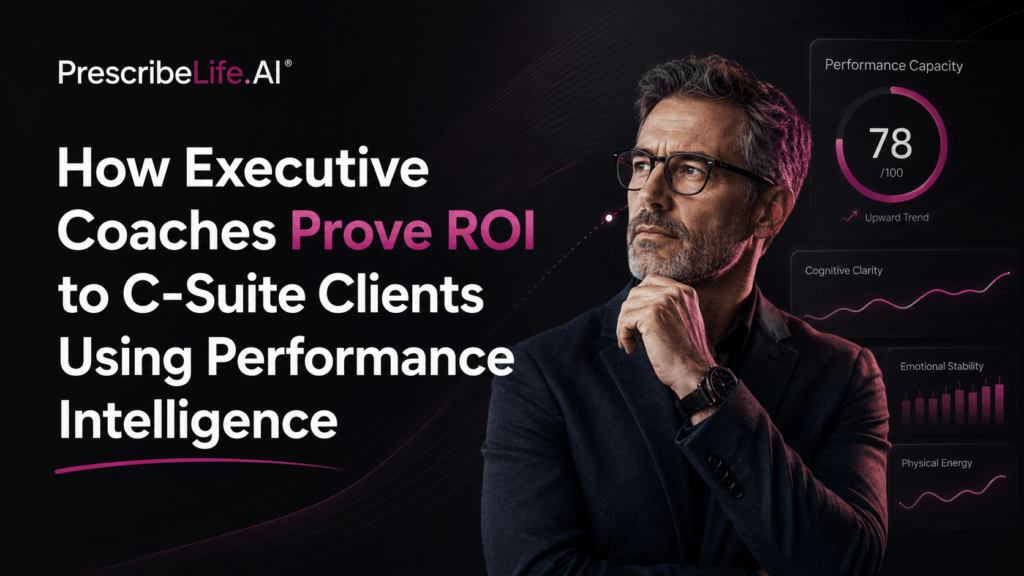
The deck describes sustainable high performance as being built on resilience capacity across three areas:
- cognitive capacity
- emotional regulation
- physical energy stability
That matters because it gives coaches a more useful way to understand what is actually happening beneath the surface.
What coaches should listen for
High-performing clients do not always say, “I think I’m burning out.”
More often, it comes out sideways.
They might say:
- “I’m getting everything done, but I feel off.”
- “I’m more reactive than I want to be.”
- “I can push through, but it’s taking more out of me.”
- “I’m not recovering like I used to.”
- “I’m doing well, but it doesn’t feel sustainable.”
- “I know what to do, but I’m not following through consistently.”
These are important signals.
Not because they prove failure.
But because they reveal strain behind performance.
For a coach, those moments matter. They are often the difference between helping a client optimize short-term output and helping them build something they can actually sustain.
The shift from performance alone to performance capacity
This is where coaching becomes much more powerful.
Instead of asking only:
“How do we get this leader even better results?”
The better question becomes:
“How do we strengthen the capacity that allows this leader to perform well without paying for it with instability?”
That shift is what makes performance capacity such a useful coaching frame.
PrescribeLife organizes that through a simple structure: build capacity, protect capacity, recover capacity.
That model matters because it gives the client and the coach a better conversation.
Not just:
- perform more
- push harder
- stay accountable
But:
- build what supports performance
- protect what keeps performance stable
- recover what gets depleted under pressure
That is a much smarter coaching conversation for leaders carrying serious demand.
Why burnout risk is often addressed too late
One of the biggest problems in leadership coaching is timing.
Many signs of unsustainable performance appear well before visible breakdown.
But if no one is measuring the right things, intervention often comes late.
The leader keeps functioning.
The coach keeps focusing on goals.
The team keeps depending on them.
The calendar keeps filling.
Until eventually the cost becomes harder to ignore.
By then, the conversation is no longer about optimization.
It is about damage control.
That is why early visibility matters so much.
The onboarding deck emphasizes that the platform gives coaches visibility into client behavioral patterns, habits, and biometrics in one place, along with the ability to set behavioral change experiments and measure results.
That matters because when you can see patterns earlier, you can coach earlier.
And when you coach earlier, the leader is more likely to preserve performance stability instead of trying to rebuild after depletion.
What the hidden cost looks like in real life
The cost of high-performing leadership is not just exhaustion.
Sometimes it looks like:
- a leader who is still delivering, but is less clear than before
- a leader who is still respected, but feels internally more volatile
- a leader who can still handle pressure, but needs longer to recover
- a leader who stays disciplined at work while personal habits start slipping
- a leader whose results remain strong while the internal experience becomes harder to sustain
This is why high performance can be misleading.
A strong exterior can hide a weakening foundation.
And if coaches only focus on the exterior, they risk reinforcing the very pattern that is costing the client most.
What better coaching looks like here
Better coaching does not shame ambition or pathologize pressure.
It helps the client become more strategic about sustainability.
That means helping them:
- recognize hidden strain earlier
- define what sustainable success actually looks like
- build small habits that support resilience
- review patterns, not just outcomes
- protect stability under ongoing demand
- recover more intentionally when performance dips
The deck’s coaching workflow reflects that kind of structured progression: create clarity, define success, design small experiments, review patterns, and adjust.
This gives the coach something more useful than vague encouragement.
It gives them a system.
Why this also matters for positioning
There is also a positioning advantage here.
Many coaching offers speak about growth, performance, mindset, or leadership.
Fewer clearly address the hidden cost behind high performance.
That is an opportunity.
A coach who can say:
“I help high-performing leaders sustain results without burning through the capacity behind those results”
sounds sharper, more relevant, and more credible than a coach offering generic improvement.
This is especially true for high-level clients.
They are rarely looking for more motivation.
They are looking for stability, clarity, resilience, and a way to keep performing at a high level without paying for it privately.
Final thought
The hidden cost of high-performing leadership is not always visible in results.
That is what makes it dangerous.
A leader can look composed while becoming less stable underneath.
A leader can stay productive while recovery weakens.
A leader can keep winning while the cost of winning keeps rising.
That is why coaches need to look deeper than performance alone.
Because the real opportunity is not just helping leaders achieve more.
It is helping them sustain performance with more clarity, more resilience, and less hidden cost.
And that is where coaching becomes far more valuable.