
When people talk about high performance, they usually talk about output.
They talk about sharper execution, better decisions, stronger leadership, bigger goals, more consistency, more growth.
That is understandable. Output is visible. It is easy to point to. It is what gets rewarded.
But sustainable high performance is not created by output alone.
It is created by the system underneath the output.
That is why one of the most useful coaching ideas is also one of the simplest:
Build. Protect. Recover.
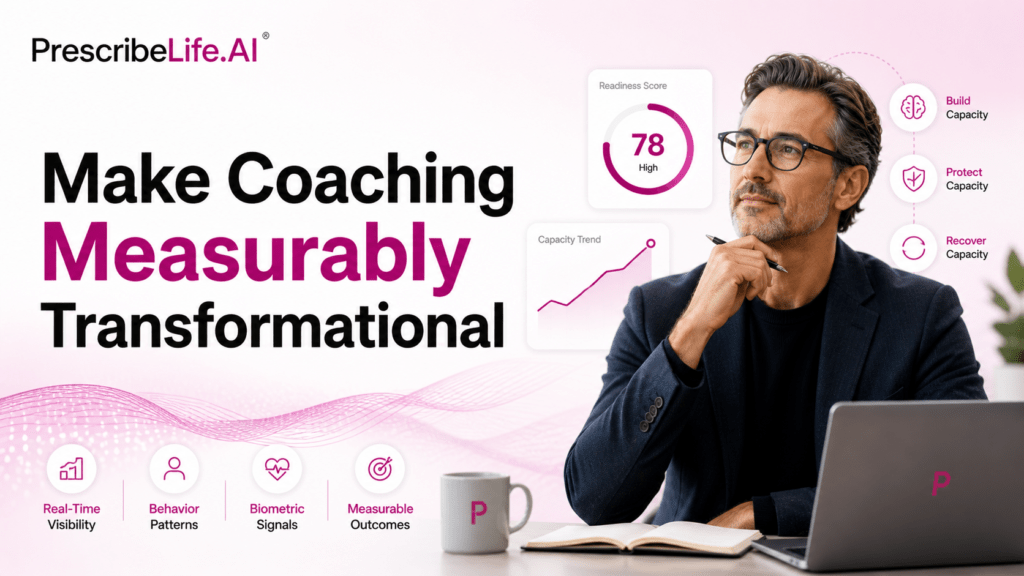
The PrescribeLife onboarding deck presents sustainable high performance leadership through these three functions and frames them as the structured path to performance stability over time.
This matters because many clients do not need a more complicated explanation of performance.
They need a better one.
Why simple models work better in coaching
Coaches often see complex patterns in their clients.
Stress, ambition, inconsistency, emotional overload, weak recovery, high standards, poor boundaries, declining energy, reactive behavior, unstable habits.
All of those can be true at the same time.
The problem is that if the model for explaining improvement becomes too abstract or too layered, the client may understand the insight without changing the behavior.
Simple models work because they create clarity.
They help the client answer three questions fast:
- What am I trying to improve?
- What is getting in the way?
- What do I do next?
Build, protect, recover does exactly that.
It turns sustainable high performance into something practical.
Not vague self-improvement.
Not generic resilience talk.
Not “just try to manage stress better.”
A real structure.
Sustainable performance is not one thing
One of the biggest mistakes in performance coaching is treating high performance like a single skill.
It is not.
A person can be highly driven and still lack stability.
They can be highly disciplined and still recover poorly.
They can be highly ambitious and still erode under pressure.
That is why sustainable performance has to be approached as a system.
The PrescribeLife deck connects this directly to performance stability and explains that sustainable high performance is built on resilience capacity across cognitive capacity, emotional regulation, and physical energy stability.
That means strong performance is not just about trying harder.
It depends on whether the person has the capacity to:
- think clearly under pressure
- regulate themselves effectively
- maintain energy and recovery
- stay consistent in the behaviors that support results
- return to baseline when stress rises
Build, protect, recover gives coaches a way to organize that system without overwhelming the client.
Part 1: Build
Building capacity means increasing a client’s ability to perform well intentionally.
This is the growth side of the model.
It is where most coaching attention naturally goes.
Clients want to improve. They want momentum. They want stronger habits, sharper execution, more focus, better routines, better results.
That is all part of building.
But in this model, building is not just about adding more.
It is about increasing useful capacity.
That could mean:
- building awareness of personal patterns
- building stronger daily behaviors
- building emotional steadiness
- building physical energy stability
- building routines that support performance under pressure
- building the confidence that comes from clearer follow-through
The PrescribeLife mobile app section reflects this idea through self-assessment, personalized performance tips, and experiments that help clients build capacity one habit at a time.
For coaches, this is important because building is often where motivation is highest. Clients usually enjoy growth-focused conversations.
They like progress.
They like activation.
They like feeling like things are moving.
But building alone is never enough.
Because what gets built can still be lost.
Part 2: Protect
This is the part many people skip.
Protecting capacity means preserving performance stability under sustained demand.
It means identifying what drains the system before the client pays too much for performance.
The deck describes protection as maintaining strong performance stability under sustained demand.
This is such an important distinction.
A lot of people know how to perform when conditions are ideal.
Far fewer know how to stay stable when pressure remains high for long periods.
Protection includes things like:
- protecting energy from constant depletion
- protecting recovery from getting crowded out
- protecting emotional regulation in high-stakes situations
- protecting focus from overload
- protecting good habits when schedules get messy
- protecting decision quality when stress rises
This is where coaching becomes more strategic.
Because the client usually does not break down due to one dramatic mistake.
They get worn down by repeated leakage.
Small costs.
Compounding strain.
Patterns that look manageable in isolation, but damaging over time.
When coaches help clients protect capacity, they are teaching them how not to lose ground unnecessarily.
That is different from growth coaching.
It is performance preservation.
And for high-level leaders, it is often just as valuable.
Part 3: Recover
Recovery is often misunderstood.
Some clients hear the word and think it means stepping back, slowing down, or doing less.
But recovery is not the opposite of high performance.
Recovery is one of the conditions that makes high performance repeatable.
The PrescribeLife model frames recovery as the ability to rebound efficiently when performance dips.
That matters because dips are inevitable.
Pressure spikes.
Sleep gets disrupted.
Travel happens.
Stress accumulates.
Energy drops.
Something slips.
The question is not whether the client will ever be strained.
The question is whether they know how to recover well when strain happens.
Recovery, in a coaching sense, can include:
- regaining clarity after overload
- restoring emotional steadiness after pressure
- returning to supportive routines after inconsistency
- rebuilding energy after intense demand
- shortening the time between disruption and regulation
This is powerful because clients do not need to be perfect to improve.
They need to become better at returning.
That is one of the most freeing and practical ideas in performance coaching.
Why this model works so well
What makes build, protect, recover useful is that it helps both the coach and the client see performance more accurately.
Instead of seeing progress as a straight line, this model treats performance as something that must be developed, stabilized, and renewed.
That creates better questions.
Instead of:
“How do I get more from this client?”
You ask:
- What are we trying to build?
- What needs protection right now?
- Where is recovery breaking down?
Those questions are more useful because they lead to different interventions.
A client who needs building may need clarity, structure, and behavior change.
A client who needs protection may need boundary work, load management, and pattern awareness.
A client who needs recovery may need support returning to baseline and regaining consistency after strain.
The model helps the coach choose the right emphasis instead of treating every problem as a motivation issue.
How this changes coaching conversations
This framework also improves how coaches communicate value.
Many coaching conversations stay stuck in broad language:
- improve performance
- reduce stress
- create better habits
- build resilience
All of that sounds good, but it can blur together.
Build, protect, recover sharpens the conversation.
For example:
- “Right now, we’re not trying to add more. We’re trying to protect what is already working.”
- “You do not need a full reset. You need a faster recovery rhythm.”
- “This month is less about pushing growth and more about stabilizing performance.”
- “The next step is to build capacity in a way you can actually sustain.”
That kind of language is easier for clients to understand.
It also makes the coach sound more precise, more strategic, and more grounded.
A better way to spot what is missing
One reason clients like this model is because it helps explain why they can be doing well and still feel off.
For example:
- A client may be building, but not protecting.
- A client may be protecting, but not recovering.
- A client may be recovering, but not building new capacity.
- A client may be strong in one area and neglected in another.
This is where the framework becomes diagnostic.
Not in a clinical sense, but in a coaching sense.
It helps reveal imbalance.
A leader who keeps growing responsibility but never protects capacity will feel success getting heavier.
A leader who protects well but never intentionally builds may plateau.
A leader who builds and protects but ignores recovery may eventually lose stability anyway.
The beauty of the model is that it makes these gaps easier to see.
How progress becomes measurable
The PrescribeLife deck strengthens this framework by linking growth to observable progress in three areas:
- resilience capacity increases
- habit consistency improves
- biometric signals improve
That is important because build, protect, recover should not stay theoretical.
It should produce visible movement.
For example:
- build may show up in stronger habits and better follow-through
- protect may show up in more stable trends under pressure
- recover may show up in improved readiness, less volatility, or quicker return to consistency
This is where the framework becomes especially useful for coaches who want to show proof of progress without reducing coaching to vague feelings alone.
Why this matters for high-performing leaders
High-performing leaders often do not need more ambition.
They need better sustainability.
That is why this model is so relevant.
It respects performance.
It respects pressure.
It respects serious responsibility.
But it also acknowledges that strong results become fragile when the system underneath them is neglected.
The PrescribeLife deck describes this shift for coaches as moving from seeing burnout risk without a structured response to systematically developing and measuring performance capacity alongside business performance.
Build, protect, recover is one of the clearest ways to make that shift practical.
It gives the coach a language for working on what is actually underneath performance.
And it gives the client a structure that feels manageable instead of abstract.
Final thought
The best coaching frameworks are not the ones that sound the smartest.
They are the ones that make action easier.
Build, protect, recover works because it gives sustainable high performance a shape people can understand.
Build what strengthens performance.
Protect what keeps it stable.
Recover what gets depleted under pressure.
Simple.
Strategic.
Useful.
And for coaches working with ambitious, high-performing clients, that kind of clarity is often what turns insight into real transformation.