One of the biggest commercial challenges in executive coaching is demonstrating measurable impact.
Most organisations investing in coaching for senior leaders and founders believe coaching creates value. The difficulty is proving that value clearly, consistently, and in terms that hold up against the scrutiny senior stakeholders apply to any significant investment.
Leadership growth is often gradual. Improvements in decision-making, emotional regulation, communication, resilience, and leadership effectiveness do not always appear immediately in traditional business metrics. As a result, many coaching engagements remain difficult to quantify.
This is the ROI measurement gap.
For executive coaches working with C-suite executives, founders, and high-performance leadership clients, this challenge is becoming increasingly significant. Premium coaching engagements now face greater pressure to demonstrate measurable outcomes, and coaches who cannot meet that expectation are commercially exposed.
Performance Intelligence is the shift that helps close that gap.
Performance Intelligence is the move from conversation-driven coaching to data-informed coaching. It gives executive coaches greater capacity for visibility through behavioural signals, physiological data, and longitudinal performance trends, and it does so without replacing the human coaching relationship.
Performance Intelligence augments coaching judgement. The coach remains central.
This article explores how executive coaches can demonstrate coaching ROI more effectively, reduce the between-session blind spot, and create more measurable leadership outcomes for organisations investing in senior leadership development.
Why Demonstrating Coaching ROI Is Difficult
Most executive coaching outcomes are not immediately visible.
Leaders may gradually become more emotionally regulated, more effective communicators, better decision-makers, or more resilient under sustained pressure. But these changes often emerge over time, not in ways that show up cleanly in financial reports or quarterly dashboards.
Traditional coaching also relies heavily on retrospective conversation. This creates the between-session blind spot.
Coaches typically only see a small portion of what clients experience between sessions, particularly when working with founders and senior executives operating in high-pressure, high-complexity environments. Without longitudinal performance visibility, coaching impact becomes difficult to measure consistently.
This is one of the core reasons many coaching engagements remain commercially vulnerable, not because they are not working, but because coaches lack the infrastructure to show that they are.
What Is the ROI Measurement Gap?
The ROI measurement gap is the difficulty executive coaches face when trying to demonstrate measurable outcomes from leadership coaching engagements.
Many coaches produce meaningful developmental results but lack the infrastructure to measure those outcomes systematically. Without structured behavioural and performance insight, coaching ROI often depends on anecdotal feedback, subjective reflection, or isolated leadership observations.
This creates challenges in renewal conversations, organisational buy-in, sponsorship expansion, and premium coaching positioning. Clients who found value in coaching may struggle to articulate that value to boards, HR leaders, or other stakeholders, which weakens the commercial foundation of the engagement.
Performance Intelligence helps close this gap. By introducing longitudinal performance data and capacity visibility, coaches can demonstrate leadership progress more clearly over time, in terms that are concrete, trackable, and credible.
How Performance Intelligence Strengthens Coaching ROI
Performance Intelligence gives executive coaches better visibility into how leadership clients are functioning between sessions.
This includes insight into behavioural patterns, recovery trends, stress accumulation, emotional regulation, and performance consistency.
For C-suite executives and founders operating under sustained pressure, these signals are often early indicators of leadership strain or performance erosion, signals that traditional coaching models may miss entirely.
Performance Intelligence creates a more structured and measurable coaching model. Rather than relying solely on retrospective conversation, coaches can combine behavioural and physiological signals, longitudinal performance trends, coaching reflection, and leadership feedback.
The result is stronger coaching insight, earlier visibility into performance risk, more measurable progress, and more defensible coaching outcomes.
The four core performance KPIs give clients and organisations a clear framework for tracking progress:
- Strategic Execution Consistency: Are leadership priorities being executed with consistency?
- Cognitive Clarity: Is decision-making quality holding under real-world pressure?
- Emotional Stability Under Pressure: Is the leader maintaining stability or showing signs of strain?
- Physical Energy Stability: Is physical energy sustaining performance or becoming a limiting factor?
These KPIs translate the abstract concept of performance capacity into something concrete and reportable, which is precisely what ROI conversations require.
What Metrics Demonstrate Coaching Effectiveness?
The strongest coaching metrics are those connected directly to leadership performance and organisational outcomes.
Examples include:
- Leadership effectiveness ratings
- Communication quality
- Emotional regulation under pressure
- Stakeholder feedback
- Team engagement
- Performance consistency
- Recovery quality
- Behavioural trends over time
For executive coaches working with senior leaders and founders, longitudinal performance data is especially valuable. Snapshot assessments only capture isolated moments. Longitudinal trends reveal whether leadership performance capacity is improving sustainably over time.
This distinction matters enormously in high-pressure executive environments, and it is the distinction that makes coaching outcomes easier to communicate in renewal and sponsorship conversations.
Measuring Performance Capacity
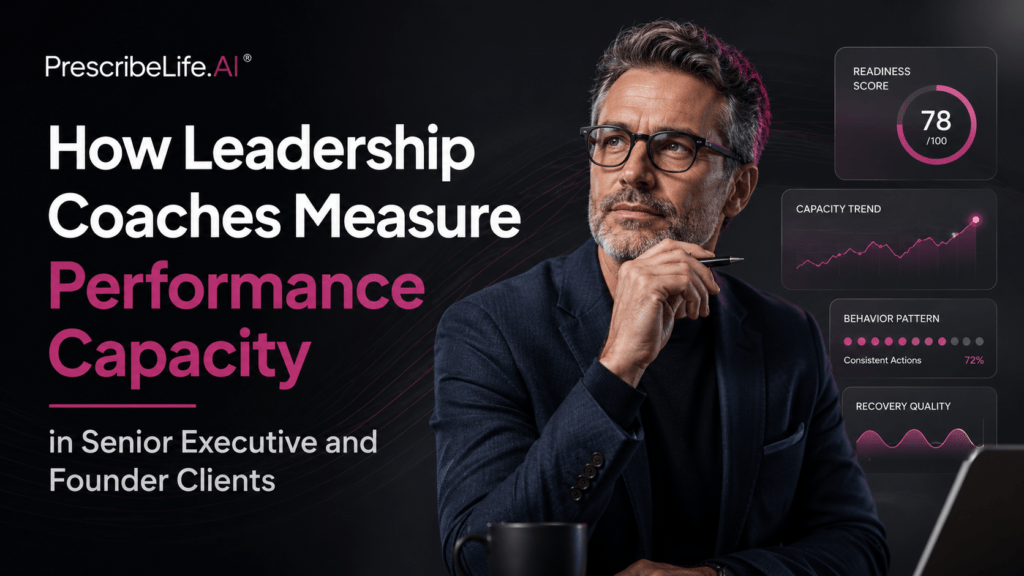
Performance capacity reflects a leader’s ability to sustain effective decision-making, emotional regulation, communication quality, and leadership effectiveness over time, even as external pressure increases.
This is one of the central concepts within Performance Intelligence.
Leadership coaches can measure performance capacity through behavioural observations, stakeholder feedback, physiological signals, recovery metrics, leadership reflections, and longitudinal trend analysis.
The goal is not to reduce leadership development to numbers. The goal is to create clearer visibility into how clients are functioning between sessions, so coaches can identify stress accumulation, behavioural drift, declining recovery, and early performance erosion before they become harder to address.
Earlier visibility creates stronger coaching intervention. A stronger coaching intervention creates outcomes that are easier to demonstrate.
Reducing the Between-Session Blind Spot
The between-session blind spot is one of the most significant structural limitations in traditional executive coaching.
Most coaching conversations occur weekly or fortnightly. But leadership pressure, board meetings, investor scrutiny, organisational conflict, and sustained operational demands happen continuously between those sessions.
Without structured visibility between sessions, important behavioural and physiological shifts can go unnoticed. Coaches arrive at the next session with no context for what has happened since the last one.
Performance Intelligence reduces this visibility gap. By combining behavioural and physiological signals with coaching expertise, coaches gain clearer insight into stress variability, recovery disruption, performance drift, communication changes, and leadership behaviour patterns.
Importantly, the role of technology here is not to automate coaching conversations. Performance Intelligence augments coaching judgement. The coach remains central. Preslie, the AI reflection companion within the PrescribeLife.AI ecosystem, supports the coaching process without replacing or overriding the coach’s judgment.
Building More Credible Coaching Programmes
Organisations increasingly expect coaching programmes to demonstrate measurable value. Executive coaches who can combine strong coaching conversations with structured performance visibility create more commercially credible engagements.
This is especially important for coaches operating at the premium end of the market, where clients are sophisticated, scrutiny is high, and the expectation of demonstrable outcomes is growing.
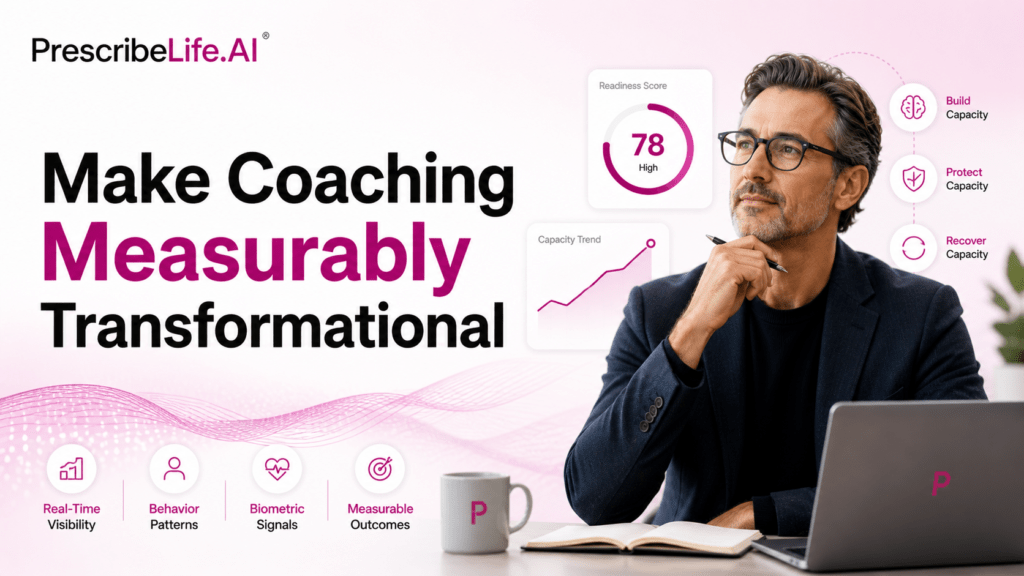
Performance Intelligence helps executive coaches strengthen ROI conversations, demonstrate measurable leadership progress, create greater client accountability, improve continuity between sessions, and support more sustainable leadership performance.
For organisations investing in senior leadership development, this creates greater confidence that coaching is producing meaningful outcomes. And for coaches, it creates a more defensible commercial position, one that is harder to challenge and easier to renew.
Frequently Asked Questions
How do executive coaches prove ROI to C-suite clients?
Executive coaches prove ROI by combining measurable leadership outcomes, behavioural trends, stakeholder feedback, and longitudinal performance data, tracked against concrete KPIs including Strategic Execution Consistency, Cognitive Clarity, Emotional Stability Under Pressure, and Physical Energy Stability.
What is Performance Intelligence in executive coaching?
Performance Intelligence is the shift from conversation-driven coaching to data-informed coaching. It combines behavioural and physiological signals, coaching insight, and longitudinal performance data to improve coaching visibility and effectiveness.
What is the between-session blind spot?
The between-session blind spot refers to the lack of visibility executive coaches have into how leadership clients are functioning between coaching conversations.
How do behavioural and physiological signals improve coaching?
Behavioural and physiological signals help coaches identify stress accumulation, recovery disruption, behavioural changes, and performance patterns earlier, before they become visible in traditional performance measures.
Does Performance Intelligence automate coaching?
No.
Performance Intelligence augments coaching judgement rather than replacing human coaching conversations. The coach remains central to the process.
Conclusion
Executive coaching is becoming increasingly measurable.
Organisations investing in senior leaders, founders, and C-suite executives want clearer evidence that coaching is producing meaningful outcomes. That expectation is not going away, and for coaches operating at the premium end of the market, the ability to meet it is becoming a commercial differentiator.
Performance Intelligence helps executive coaches meet that expectation.
By combining behavioural and physiological signals with coaching expertise and longitudinal performance data, coaches can reduce the between-session blind spot, demonstrate stronger ROI, and create more sustainable leadership performance.
The future of executive coaching is not purely conversational. And it is not purely technological.
It is informed, measurable, and deeply human.
That is the shift Performance Intelligence is helping define. And for coaches working at the premium end of leadership development, it is becoming essential infrastructure.